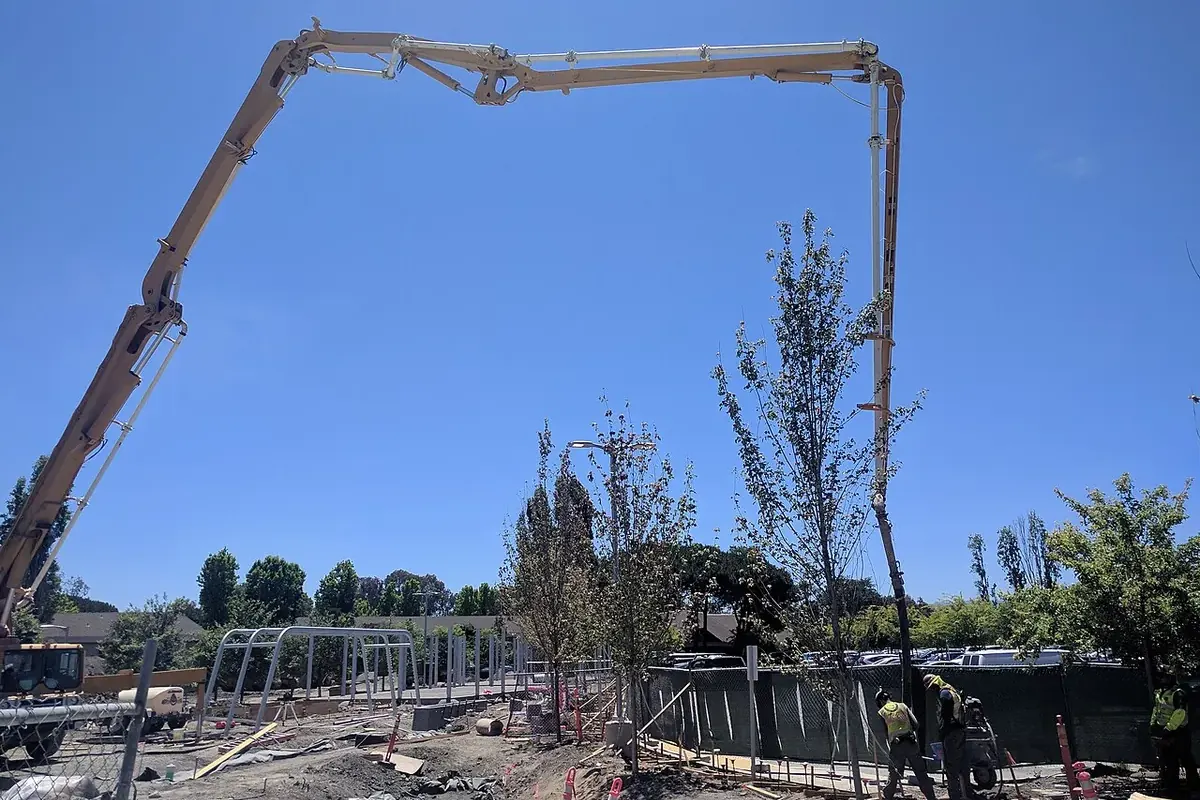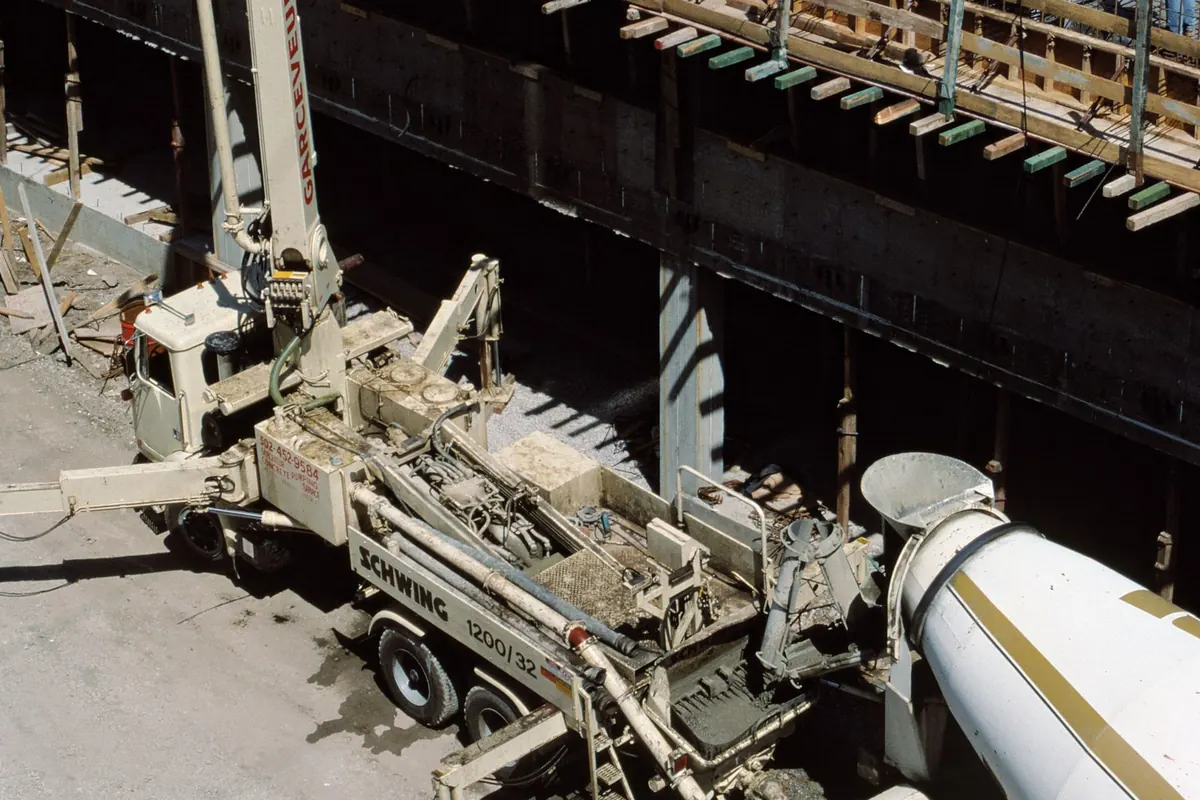
Commercial concrete work in Pasadena
Commercial concrete is mostly the same material as a driveway, poured to a different set of demands: more people walking on it, delivery trucks and trash trucks driving on it, accessibility rules on every route to the door, and an owner who can't close for a week. Around Pasadena that means storefront walks along Colorado Boulevard and Lake Avenue, parking pads behind small offices, courtyards at apartment buildings, and the trash enclosures every one of them needs.
Walks, entry slabs and courtyards
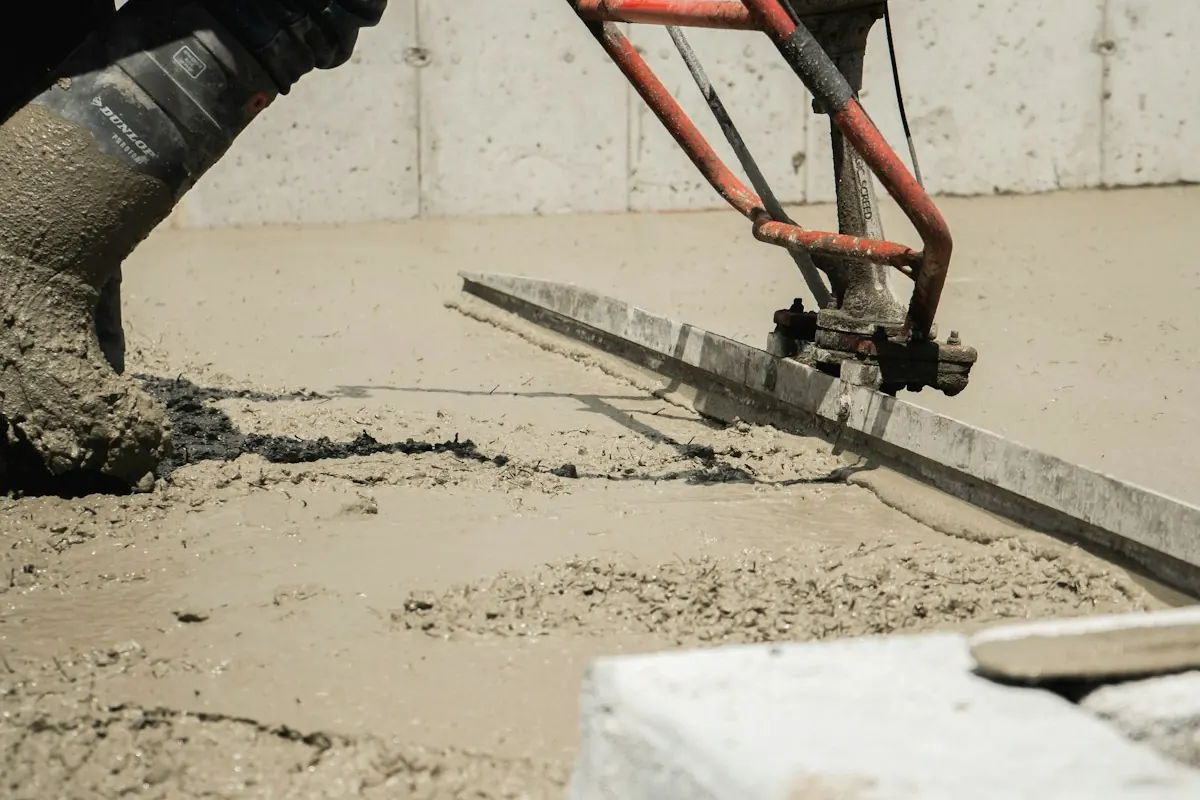
Entry walks and slabs take the most foot traffic on the property, so they get a broom finish for grip, joints laid out so cracks stay in straight lines, and a slope that sends rain away from the doors. Where a walk is part of the accessible route from parking or the street, its slopes are set to California's Chapter 11B limits; see ADA concrete ramps in Pasadena.
Parking pads, drive aisles and wheel stops
Concrete outlasts asphalt where trucks turn and park, which is why trash pickup areas and loading spots are often concrete even when the rest of the lot is asphalt. These slabs are thicker, reinforced, and jointed at closer spacing than a house driveway. Concrete wheel stops are set and anchored on the finished surface.
Trash enclosure and equipment pads
A trash enclosure pad carries a loaded bin and the front wheels of the truck that lifts it, so it is poured thick and reinforced, with an apron in front where the truck stops. Equipment pads for condensers, generators and similar units are smaller slabs sized to the equipment maker's footprint and set level above the surrounding grade.
Curbs, gutters and the sidewalk out front
The sidewalk, curb, gutter and driveway approach in front of a commercial property sit in the public right-of-way, so they are built to City standards under a Public Works permit. See curb, gutter and sidewalk in Pasadena and the guide to Pasadena driveway permits and curb cuts.
Repairs
Trip edges, broken panels and spalled steps on a commercial property are a liability, not just an eyesore. Sound slabs can be repaired; broken or heaved panels are saw-cut out and replaced. See concrete repair in Pasadena.
Commercial concrete costs in Pasadena, 2026
| Work | Price | Source |
|---|---|---|
| Walks, entry slabs, parking pads (reinforced) | $8 to $15 per sq ft | constructlytools LA, May 2026 |
| Break out and haul old concrete | $1.40 to $2.30 per sq ft | constructlytools LA, May 2026 |
| Small pads (trash enclosure, equipment, storage) | $10 to $15 per sq ft | constructlytools LA, May 2026 (storage pads) |
| Concrete pad, national average | $9.81 to $12.05 per sq ft | Homewyse, May 2026 |
| Concrete curb and gutter | $63.32 to $77.78 per linear ft | Homewyse, May 2026 (national) |
| Concrete wheel stops, installed | $65 to $125 per stop | Bowman Parking Lot Striping (Southern California) |
| Concrete pump, when a truck can't reach | $500 to $900 | constructlytools LA, May 2026 |
Swipe the table sideways to see every column →
National figures are averages; Los Angeles quotes usually land at or above them. Phasing, after-hours work, traffic control and permits are priced per job.
A 600 square foot parking pad at $8 to $15 per square foot is $4,800 to $9,000 before breaking out the old slab, which adds $840 to $1,380 at $1.40 to $2.30 per square foot. The concrete cost calculator runs the same numbers for any size.
Rules that shape commercial concrete in Pasadena
- Accessibility: routes from parking and the street to the entrance follow California Building Code Chapter 11B: ramps no steeper than 1:12, cross slopes no steeper than 1:48, 48 inch clear width on ramps.
- Right-of-way: sidewalk, curb, gutter and driveway approach work at the street goes through Pasadena Public Works.
- Historic districts: properties in a designated district or landmark may need design review before exterior changes; see the historic district guide.
- Stormwater: concrete wash water may not go to the storm drain; washout is contained on site (California stormwater BMP handbook, WM-8).
- Licensing: stand-alone concrete is C-8 work under CSLB rules; public works over $1,000 pay prevailing wage.
More on the local rules: Pasadena historic district hardscape rules and Pasadena stormwater and low impact development.
How a commercial concrete job runs
- 1Walk the site
Measure the area, check slopes and drainage, note where people and cars move, and find out what has to stay open.
- 2Scope and quote
A written scope: square footage, thickness and steel, demolition, finish, joints, accessibility details and any permits.
- 3Permits and schedule
Right-of-way work goes through Public Works; work is phased around open hours, deliveries and tenant access.
- 4Demo, form and pour
Old concrete is saw-cut and hauled, the base is compacted, forms and steel are set, then the pour and finish.
- 5Cure and reopen
Foot traffic and vehicles come back only once the concrete has cured enough for each.