Driveway resurfacing in Pasadena: when it works
Resurfacing puts a thin, bonded layer of new material over the old driveway: a polymer-modified cement overlay, a microtopping, or a stamped or textured overlay. It changes the surface, not the structure. On a driveway that is still one solid, level piece, that is often all it needs. On one that is moving, it is money spent twice.
Many Pasadena driveways are old enough that the answer isn't obvious. A 1920s drive may be sound concrete with decades of stains and a few hairline cracks, or it may be thin, unreinforced and broken where a parkway tree's roots reach under it. The checklist below sorts one from the other.
Resurface, repair or replace: the signs
| What you see | Usual answer | Why |
|---|---|---|
| Stains, worn finish, light scaling | Resurface | The slab is fine; only the top is tired |
| Hairline cracks that don't move | Resurface or seal cracks | Fine cracks can be filled and covered |
| One cracked or broken panel | Repair that panel | Cut out and repour between joints |
| A panel sunk but in one piece | Lift or replace | Leveling is a separate trade; washed-out base means repour |
| Wide cracks that open and close | Replace | The slab is moving; an overlay would crack too |
| Root heave, lifted edges | Replace the section | Roots keep pushing; deal with them first |
| Many broken pieces, crumbling edges | Replace | Nothing solid left to bond to |
Swipe the table sideways to see every column →
Quick test before you ask for a quote
- Lay a straightedge or level across the cracks: if one side sits higher, the slab has moved
- Watch a crack over a season: if it gets wider, it is still moving
- Hose the driveway: water pooling against the garage or the house points to settlement
- Look under the edges: soil washed out from beneath means the base has failed
- Check where tree roots run: a crack that follows a root line will come back
What each option fixes, and what it doesn't
Resurfacing
Fixes appearance, minor scaling and surface texture, and can add color or a stamped pattern. It doesn't fix movement, drainage problems or a weak base, and it raises the surface slightly, so the transition at the garage and the street needs attention.
Repair
Cutting out and repouring a damaged panel between joints fixes a local problem, such as one broken corner or a single panel over a soft spot. The new concrete won't match the old exactly in color, which is why some owners resurface the whole drive afterward. The concrete repair and resurfacing page covers crack repair in more detail.
Replacement
Breaking out the old driveway and pouring a new one fixes everything at once: base, drainage, thickness, steel and finish. It is the most expensive option and the only real one for a driveway that has failed. The concrete driveway page covers the Pasadena spec for a new one.
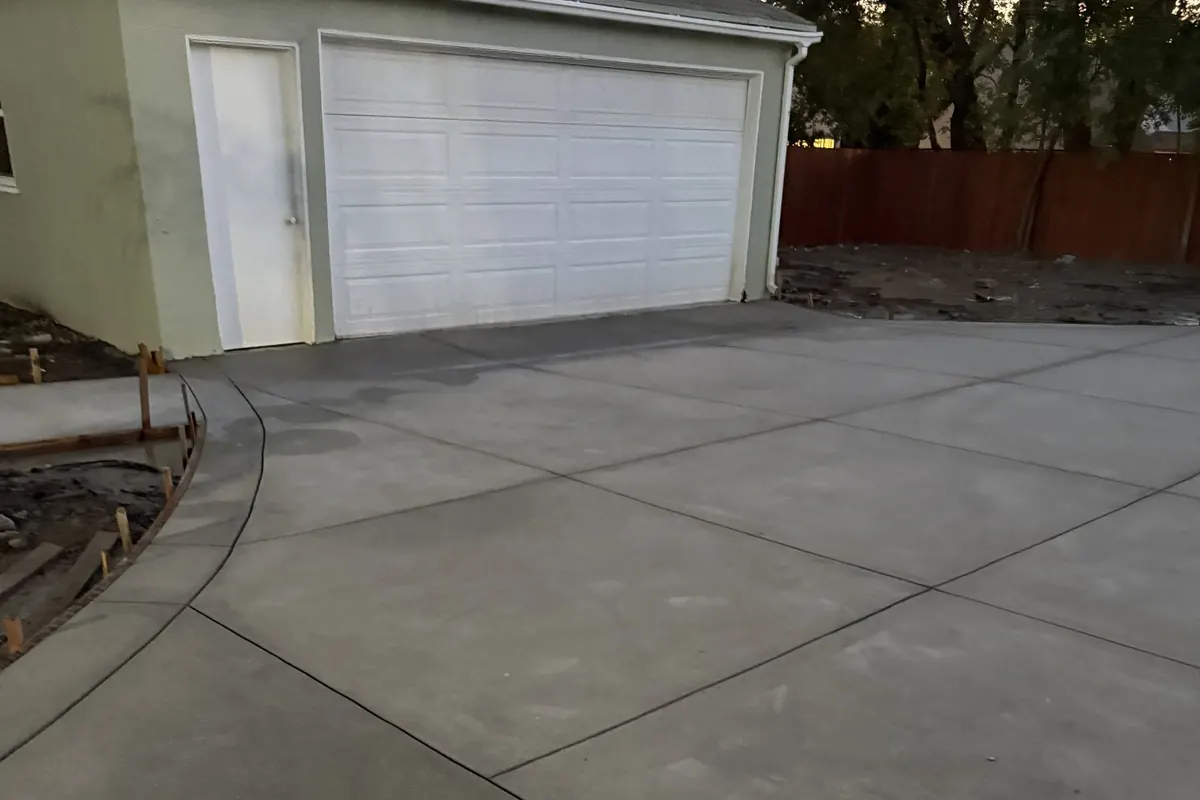
Driveway resurfacing vs replacement cost in Pasadena
Replacement is the option with published numbers: new reinforced concrete at $8 to $15 per square foot installed, plus $1.40 to $2.30 per square foot to break out the old slab, from constructlytools' Los Angeles guide (updated May 19, 2026). The guide says demolition bundled with the new pour is discounted 10 to 18 percent. Resurfacing and spot repairs are quoted per job because the prep work depends entirely on the slab. An overlay generally comes in below a full replacement; whether it is the better value depends on how long the slab under it will stay put.
| Item | Low | High |
|---|---|---|
| Break out old slab ($1.40 to $2.30 per sq ft) | $1,120 | $1,840 |
| New reinforced concrete ($8 to $15 per sq ft) | $6,400 | $12,000 |
| Total | $7,520 | $13,840 |
Swipe the table sideways to see every column →
Computed from constructlytools' 2026 Los Angeles rates (guide updated May 19, 2026); quotes vary by site.
More sizes are on the concrete driveway cost in Pasadena page.